
The principles of researching the mutual influence of dances (using the example of tango and its predecessors)
(Dmitry Nikitin)
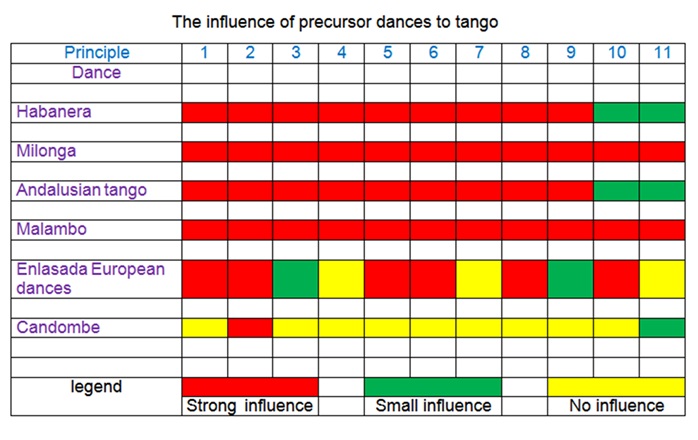
The history of the tango's formation (1854–ca. 1900) is well documented. This world-famous dance is truly folk and has absorbed various cultural traditions. It provides a useful model for researching the mutual influence of dances. Studying the history of the tango and analysing its predecessors, such as the Habanera, the Milonga, the Andalusian tango, the Malambo, the European enlazar dances and the Candombe, allows us to formulate the principles proposed below:
 Gradual changes over time.
- Contact between dances in space and time.
- Rhythm and other musical characteristics.
- Identical lyrics, sizes and themes.
- Changes in choreography, including not only movements and figures, but also types of sets, drama, participants and their roles.
- Same native dancers.
- Similar ideas.
- The existence of a borrowing mechanism, including its goals and reasons.
- Presenting the dance to borrowers in a way they can understand.
- The borrowed dance should be widely represented.
- Conducting a linguistic study of dance-related words.
Thus, researching the mutual influence between dances is a multifactorial procedure. The same principles should be applied to the process of reconstructing historical dances. The table below shows the influence of predecessor dances on tango.
Dmitry Nikitin, Vladimir, Russia
 Dmitry Nikitin began to study historical social dance in 1975 at the age of 16 under the guidance of the choreographer-methodist of the Ministry of Culture of the USSR Golden O. D. For a long time, he worked in the system of higher and special education, and also taught various types of dance. He obtained his PhD in 1989. In 2011, he founded the Historical and Social Dance Club in Vladimir. He is currently its head and teacher. His areas of activity include the reconstruction of 19th-century and modern dances, dance theory, and the theory and practice of dance pedagogy, as well as the organisation of historical events. He has published several articles on dance reconstruction and delivered lectures at conferences.
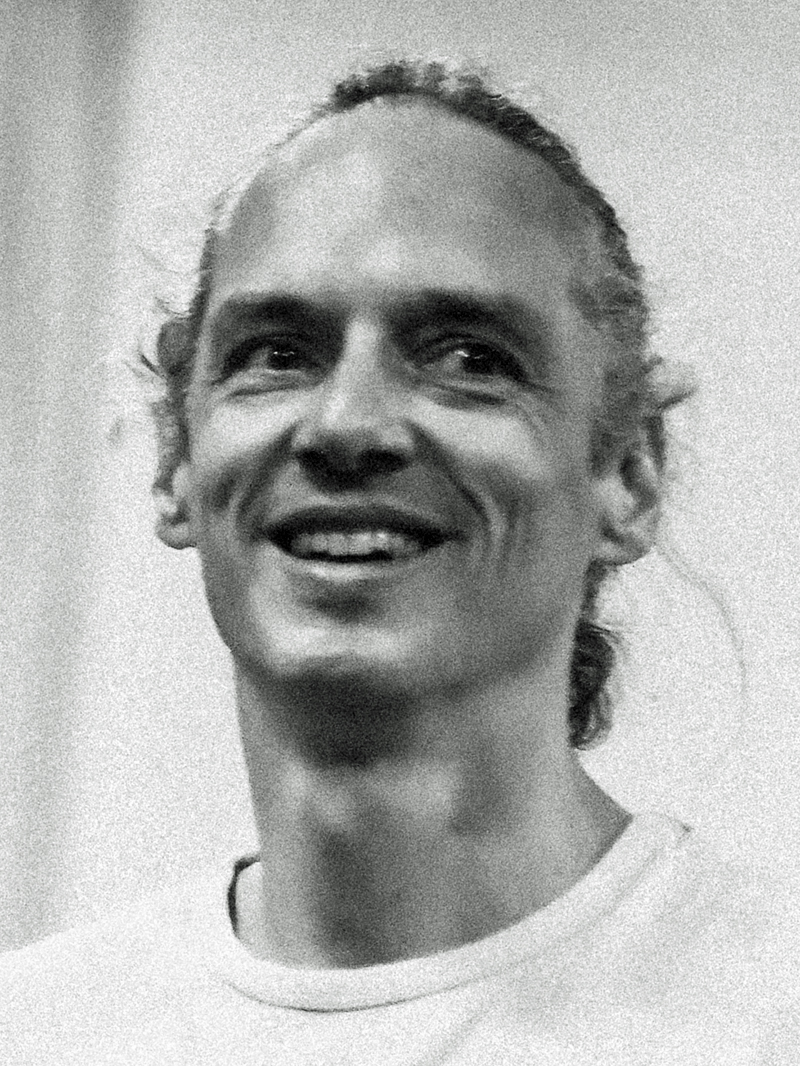 Guillaume Jablonka's career as a dancer took him to the Ballet du Nord (Roubaix), where he met Jean Guizerix and Wilfride Piollet, before incorporating their Barres Flexibles into his training and teaching. He discovered Baroque dance with Marie-Geneviève Massé's Cie l'Éventail and went on to found the Cie Divertimenty, creating Le Petit Chaperon rouge as a pantomime ballet (Festival Baroque de Pontoise) and Les Coulisses du Ballet vénitien (Opéra-Comique). At the same time, his research focuses on the reconstruction of dances notated during the eighteenth century, notably in the Ferrère manuscript. He has benefited from the Centre National de la Danse's Aide à la Recherche et au Patrimoine en Danse scheme in 2011 and 2020. As ballet master, he contributes to the practical application of the sources in performances at the Théâtre Molière Sorbonne.
 Paris-based researcher and choreographer Alan Jones has given papers and classes at Burg Rothenfels on a number of occasions. Having performed Baroque dance widely in North America and Europe from the 1980s into the early 2000s, he now gives priority to choreographies of the late 18th and early 19th centuries, principally those of the United States. A frequent collaborator with the New York Baroque Dance Company (Catherine Turocy, director), he recently realized a suite of American dances for the company, including the Congo Minuet; this project was conducted in collaboration with Julia Bengtsson, and with support from the Centre National de la Danse. In addition to papers at Burg Rothenfels, he has presented at conferences hosted by the City University of New York, the court theater of Český Krumlov, and the Centre de Musique Baroque de Versailles, among others. He is presently laying the groundwork for a website chronicling all the dancers, ballet masters, and dancing masters active in the early United States, along with the repertory they created. Contact: